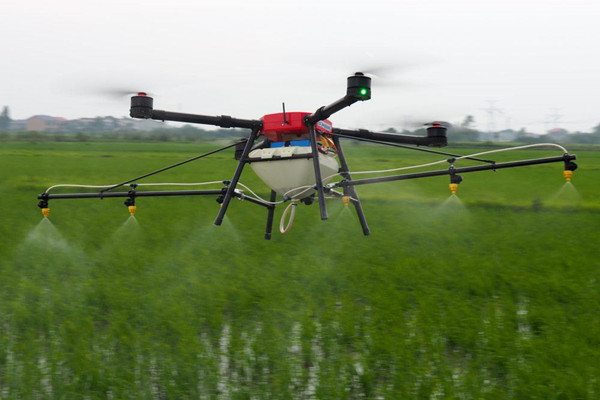
Broad Application Prospects of Drones in Agriculture
Drone aerial seeding refers to the use of drone for agriculture, forestry, and animal husbandry seeding, fertilizer spraying and fishery feed delivery, to improve production efficiency, reduce manual labor, and cut production costs.
The drone seeding & spraying is accurate and efficient, and suitable for small plots below 67 hectares. It is less costly, easy to operate, safe and convenient, and is more suitable for China's agricultural conditions.
In fact, the seeding & spraying market can be divided into a variety of sub-applications. One is the aerial seeding market, including agriculture, forestry and animal husbandry, and the main applications are direct seeding of crops, tree species and grass seeds. The second is the aerial seeding market, and the main application is fertilizer spreading, which includes spraying chemical fertilizer, organic fertilizer and soil fertilizer in theory, and can be divided into granular fertilizer, powder fertilizer and liquid fertilizer in shape. The third application scenario is feedstuff delivery for aquaculture. Besides, drones can be used for disaster relief purposes such as sowing snow melting agents.
The rice planting area in China totals 32 million hectares, the wheat planting area 24 million hectares, the corn planting area 60 million hectares, the soybean planting area 12 million hectares, the rape planting area 10 million hectares, and the cotton planting area 5 million hectares. Under the background of the rapid aging of China's rural population, the drone seeding & spraying system with roller quantity and air injection technology will cover an area of over 120 million hectares, with a market value of around US$1.2 billion.
The seeding & spraying system can also spray granular fertilizers and pesticides. Under the policy of zero-growth in the use of chemical fertilizers and pesticides advocated by the state, many pesticide and fertilizer enterprises have developed fertilizer products with high concentration and slow release, which are more suitable for drone spraying. Drone spraying operation has the advantages of high efficiency and high precision and can reduce the use of fertilizer by 10%, which will help to further boost the market demand for aerial seeding. Based on the average spraying rate of 2 times for rice, wheat, maize, soybean, cotton and other major crops at a service fee of US$20 per hectare, the market value can reach US$5 billion. In addition, aerial seeding can also be applied to sow grass and feed.
Efficiency and precision are the greatest advantages of drone seeding & spraying, which will become the mainstream of seeding & spraying in the future, with an annual market value of more than U$20 billion.